
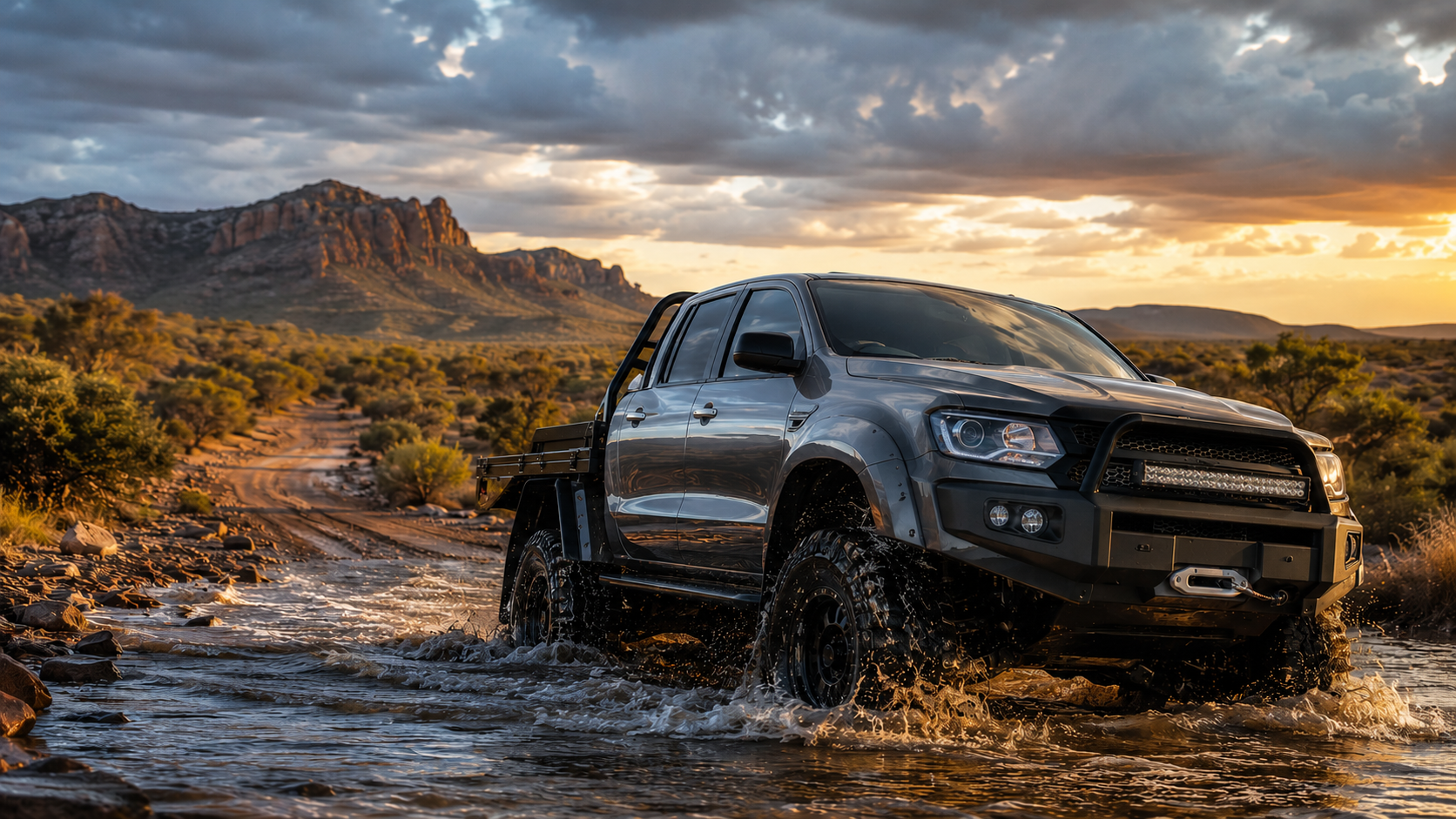
If you own a 4WD in Australia and you’re serious about getting off the bitumen, a snorkel isn’t a styling accessory , it’s a survival tool. From the dust bowls of the Simpson to the river crossings of Cape York and the salty beach runs on Fraser Island, your engine is constantly fighting to breathe
clean, dry air. A factory airbox sitting low in the engine bay is the worst place for that to happen.
A 4-inch stainless steel snorkel changes the game. It relocates your air intake to roof height, where the air is cooler, cleaner and far less likely to be sucked full of water, dust or sand. Done right , with the correct grade of stainless, a tidy guard cut and the proper silicone joiners , it’s the single best reliability upgrade you can make to a modern turbo-diesel 4WD.
This guide walks you through everything: how snorkels actually work, why 4 inch is now the Australian standard, what to look for in a quality stainless build, fitment notes for popular utes like the Toyota Hilux, Nissan Navara, Ford Ranger and Isuzu D-MAX, and the install considerations that separate a 10-year snorkel from one that leaks after 12 months.
What a Snorkel Actually Does (and Doesn’t Do)
A snorkel is, at its simplest, a sealed air duct that runs from the standard airbox up the side of the A-pillar to a head positioned at roof height. Instead of drawing air from inside the engine bay, the engine pulls cool ambient air from above the cabin. Three things happen because of that.
First, Water Ingestion Risk Drops Dramatically
The single fastest way to destroy a diesel engine is hydraulic lock , water entering the cylinders during a creek crossing. Water doesn’t compress. The piston tries to compress it, the connecting rod bends or the head cracks, and you’re looking at a five-figure repair bill. A properly sealed snorkel raises the safe wading depth from somewhere around bonnet height to roof height.
Second, Dust Contamination Drops
The dirtiest air in a 4WD convoy is at wheel level , exactly where your factory airbox lives. Lifting the intake to roof height pulls cleaner air, which means your air filter lasts longer, your MAF sensor stays cleaner and your turbo enjoys a much easier life.
Third, Intake Air Temperature Falls
Underbonnet air on a 40-degree Aussie day can easily hit 70-80°C from radiator and turbo heat. Roof-height air is far closer to ambient. Cooler air is denser, denser air burns fuel more efficiently, and you’ll often notice slightly better fuel economy and a cleaner-revving engine, especially when towing.
What a snorkel won’t do is magically add power on its own. It’s an enabler , it lets the engine breathe properly when conditions are tough. Pair it with a quality intercooler hose, a good air filter and clean tuning, and the gains compound.
Why 4-Inch Is the Australian Standard
Walk through any aftermarket 4WD shop on the Gold Coast or in regional Queensland and you’ll see one diameter dominating the wall , 4 inch. There’s a reason.
Most modern 3.0L–2.8L turbo-diesel utes flow somewhere between 350 and 450 cubic feet per minute under boost. A 3-inch snorkel can become a restriction at the top of the rev range, especially once you’ve added a tune or a free-flowing exhaust. A 4-inch tube has roughly 78% more cross-sectional area, which removes the snorkel as a bottleneck for any factory or mildly-modded engine.
The bigger tube also handles dust storms and torrential rain better. A larger volume of air moves more slowly past the head, giving water and heavy particles time to fall out before they reach the airbox. Combined with a proper pre-cleaner head, you can drive through some genuinely ugly conditions and still pull a clean filter at the end of the trip.
316 vs 304 Stainless Steel: What You’re Actually Buying
Not all stainless is created equal. The two grades you’ll see in 4WD snorkels are 304 and 316.
Grade 304
Grade 304 is the most common stainless on the market. It resists corrosion well in normal conditions and looks great polished. It’s perfectly fine for inland 4WDs that don’t see much salt.
Grade 316
Grade 316 contains added molybdenum, which dramatically improves resistance to chloride attack , the kind of corrosion you get from sea spray, beach driving and the salt fogs you encounter on coastal trips. If your 4WD spends time at Inskip Point, Stockton, Fraser, or any North Queensland beach, 316 is worth the small premium.
Wall thickness matters as much as alloy. A snorkel made from 1.6 mm stainless will outlive a 1.2 mm tube by years, especially if it ever cops a stick or branch. Hand-built Australian snorkels using mandrel-bent tube and TIG-welded joints , like the units fabricated locally on the Gold Coast , are dimensionally accurate and survive the kind of vibration that cracks cheap mass-produced units.
Vehicle-Specific Fitment Notes
Toyota Hilux N70 (2005-2015) and N80 (2015-current)
Both platforms are well-supported with off-the-shelf stainless snorkels designed to recess neatly into the front guard. The N80 in particular benefits from a 4-inch unit because the factory plastic intake is restrictive once tuned.
Nissan Navara D40 and NP300 D23
The NP300’s intake plumbing is famously fragile, and a stainless snorkel paired with an upgraded throttle body pipe is one of the highest-value combos you can run. Templates are available to align the head correctly with the A-pillar without ugly gaps.
Ford Ranger PX1/PX2/PX3 and Next-Gen
The Ranger drinks air, particularly when tuned. A 4-inch stainless unit sized to match the airbox inlet is the right call.
Isuzu D-MAX and MU-X
Both vehicles have well-mapped fitment patterns and fit nicely with hand-built stainless heads.
Whatever the platform, the install isn’t a 30-minute weekend job. Cutting the guard accurately, sealing the airbox properly, and choosing the right mounting hardware are the difference between a snorkel that lasts a decade and one that whistles, leaks or rusts at the cut line.
Installation: What Separates a 5-Minute Job from a Lifetime Job
A correctly fitted stainless snorkel takes a competent installer between 3 and 5 hours. The non-negotiable steps are: marking and cutting the guard with a template (never freehand), sealing every hole with rubber pinch weld and silicone, using stainless nutserts rather than self-tappers, fitting silicone joiners with stainless hose clamps at the airbox connection, and pressure-testing the system once it’s bolted up.
The most common mistake on DIY installs is leaving an unsealed gap at the airbox-to-snorkel junction. If that joint isn’t airtight, dust gets in and you’ve defeated the entire purpose. The second most common is over-tightening hose clamps and crushing the silicone joiner , a quick pressure test with a smoke machine will reveal both faults immediately.
If you’re in South-East Queensland and you’d rather have it done once and done right, professional installation usually adds a few hundred dollars to the snorkel cost and includes the guard cut, sealing, joiner fit-up, and a proper post-install check.
Maintenance and Long-Term Care
Stainless is low-maintenance, not no-maintenance. Wipe the snorkel down after beach trips with fresh water to flush salt out of the head. Check the silicone joiners annually for cracks. Inspect hose clamps for tension after long corrugated tracks. Keep an eye on the rubber rain cap if your snorkel uses one , UV will perish it eventually.
Done well, a 4-inch stainless snorkel is one of the few mods you fit once and forget about for the life of the vehicle.
Frequently Asked Questions
Q: How deep can I drive with a 4-inch snorkel fitted?
A: The snorkel itself raises the safe wading depth to roof height, but your vehicle’s actual wading depth is limited by other factors , diff breathers, ECU location, alternator height and door seals. Most 4WDs with snorkel and breathers fitted are safely good for chassis-deep water at a steady walking pace. Always walk a crossing first.
Q: Will a snorkel void my new car warranty?
A: Under Australian Consumer Law, a manufacturer cannot void your entire warranty for fitting an aftermarket part. They can decline a claim that’s directly caused by the modification, but unrelated warranty items (transmission, infotainment, paint) remain covered. A properly fitted snorkel that doesn’t modify the airbox should not affect engine warranty.
Q: Is a stainless snorkel worth the extra cost over plastic?
A: Yes, for two reasons: longevity and looks. Plastic snorkels go chalky and brittle after 4-5 years of Aussie sun. Stainless looks the same in 10 years as the day it went on, won’t crack from a tree branch, and holds resale value when you sell the vehicle.
Q: Can I install a snorkel myself?
A: Mechanically capable owners can absolutely fit one at home with the right tools , hole saw, jigsaw, rivet gun and a steady hand. The risk is cutting the guard wrong, which is an expensive mistake. If you’re not 100% confident, paying for professional installation is cheap insurance.
Q: Will a 4-inch snorkel make my 4WD louder?
A: Slightly , you’ll hear a deeper intake note under hard acceleration, which most owners actually enjoy. At cruise it’s no louder than stock.
Q: Do I need a pre-cleaner on top of my snorkel?
A: If you spend serious time on dusty Outback tracks (Birdsville, Tanami, Plenty Highway), yes , a cyclonic pre-cleaner significantly extends air filter life. For typical weekend 4WDing, a standard ram or rain cap is fine.
Q: How long does a quality stainless snorkel last?
A: A 316-grade hand-built stainless snorkel, properly installed, will outlive the vehicle. We see 10-15 year old units come back through the workshop still going strong.